
Cultural Consumption Barometer 2023 – Consumer communities in the context of societal changes
2024
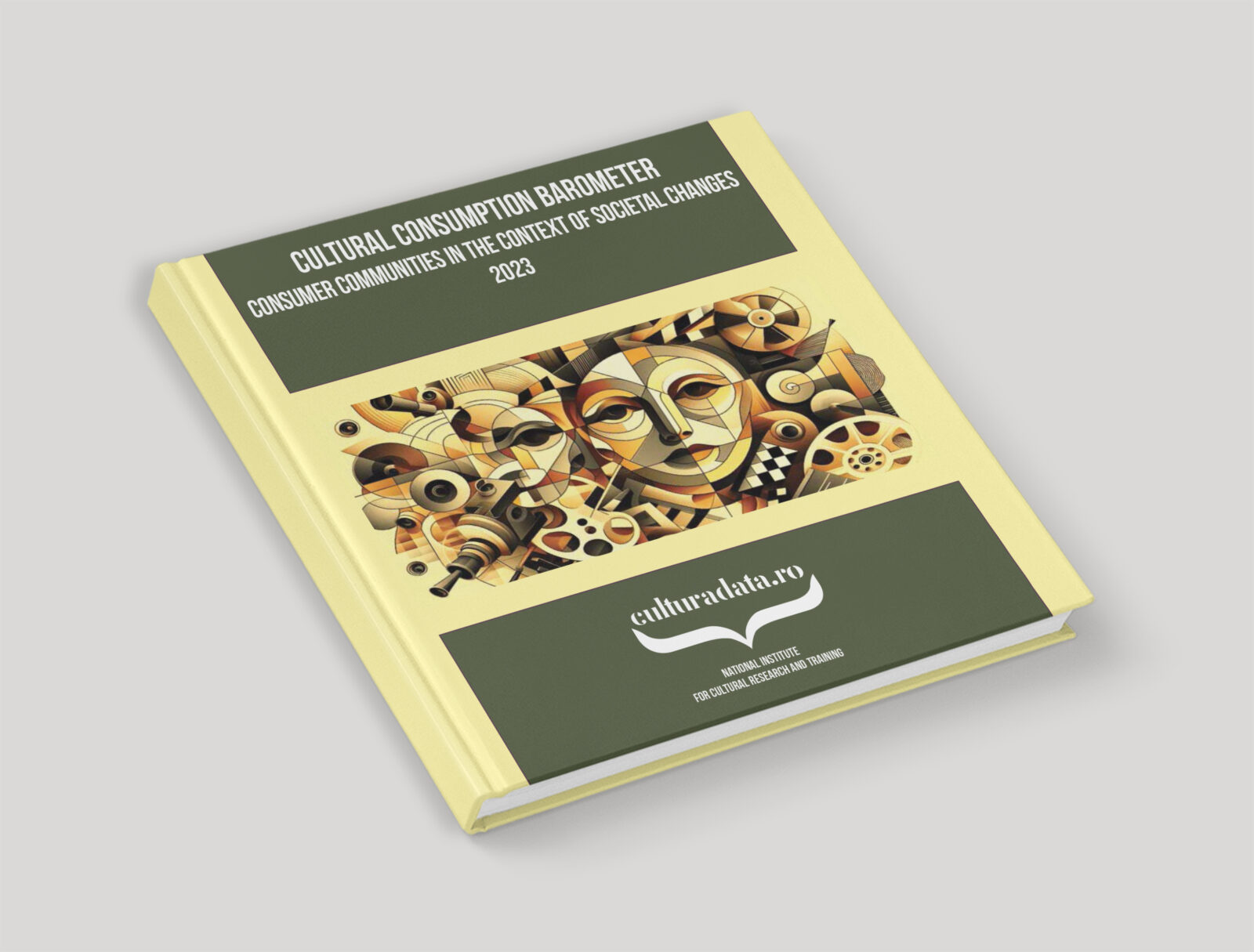
Description
Dedicated to the topic of consumer communities in the context of societal change, the Cultural Consumption Barometer 2023 presents, for the first time, an extended analysis and classification of cultural consumption groups active in the public space in Romania, from the perspective of the effects that culture, as a public good, has on society as a whole.
The study also measures the changes recorded in non-public cultural activities, with a focus on music and reading consumption profiles, and highlights the characteristics of film consumption in the traditional distribution system and “off-network” (“streaming”).
At the level of public cultural consumption, the frequency of visiting culturally relevant sites has increased rapidly: 67% of respondents visited historical monuments and archaeological sites at least once a year in 2023, compared to 59% in 2022, while 45% visited a museum, exhibition, or art gallery at least once a year in 2023, compared to 30% in 2022. At the same time, 34% of respondents went to the cinema at least once in 2023, a percentage close to pre-pandemic figures. The percentage of respondents who went at least once a year to the library to borrow books (20%) in 2023 is similar to the percentage of respondents who attended a book fair at least once a year (16%). However, participation in performing arts events, outside festivals, remains low: only 25% of respondents attended at least one theatre performance, and 24% attended at least one classical music performance in 2023.
Among public-space cultural activities, it is worth noting that over 50% of young people aged 18 to 35 attended at least one music festival in 2023, and 40% attended food festivals. Approximately 20% of young people attended film and theatre festivals in 2023, and 15% attended literature festivals.
The data provided in the Cultural Consumption Barometer 2023 show that, at the level of cultural consumption communities identified in Romanian society, a quarter of the population constitutes the public receptive to culture in the public space, while at the opposite end, half of the study participants have no direct contact with cultural or artistic products.
The results underline the need for designing adapted cultural strategies and policies, especially policies promoting access to culture, given that in Romania, public-space cultural consumption communities function as amplifiers of social inequalities.
The Cultural Consumption Barometer 2023 study is based on an opinion survey conducted by the Romanian Institute for Evaluation and Strategy (IRES), during September – October 2023, on a nationally representative sample of the population aged 18 and over. The approximate sample size is 1,035 people, with a maximum margin of error of +/-3.1%, at a 95% confidence level. The questionnaires were applied using the CATI method, on a simple, random sample, by generating phone numbers in valid formats in Romania, through the RDD (Random Digit Dialing) method.
Table of contents
1. Carmen Croitoru, Anda Becuț Marinescu – Introduction and methodology
2. Carmen Croitoru, Ștefania Matei – Public cultural consumption groups – motivations and classifications
3. Ioana Ceobanu – Non-public cultural consumption. Reading and music consumption profiles
4. Anda Becuț Marinescu, Lucian Georgescu – Characteristics of film consumption in the legacy and “off-network” broadcasting system (streaming)
About
Coordinators
- dr. Carmen Croitoru, dr. Anda Becuț Marinescu
Authors
-
conf. univ. dr. Carmen Croitoru (coordonator), dr. Anda Becuț Marinescu (coordonator),
Ioana Ceobanu, prof. univ. dr. Lucian Georgescu, dr. Ștefania Matei
Editura
- Universitaria Publishing House, Craiova, 2024
- Universul Academic Publishing House, Bucharest, 2024
- ISSN 2393-3062
- ISBN 978-630-6590-22-3
- ISBN 978-606-14-2093-3
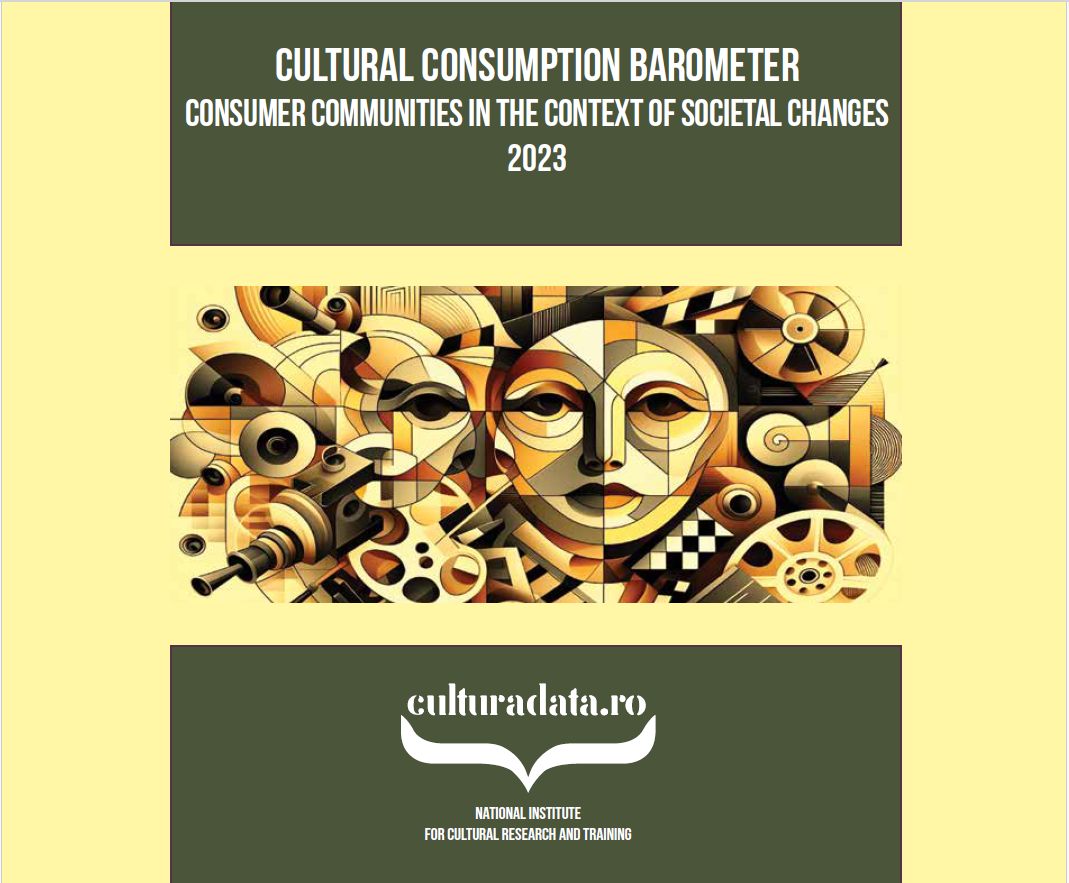
Publication preview
Related publications

- Volumes
The 2022 Cultural Consumption Barometer. Cultural Participation and Democratic Perspectives
2023
- Studies, Volumes
The Cultural Vitality of Cities in Romania – 2018 edition
2019
![White Paper for Unlocking the Economic Potential of the Cultural and Creative Sectors in Romania [2016]](https://www.culturadata.ro/wp-content/uploads/2017/01/2017_Cartea_Alba_ENFR_Mock-150x150.jpg)
- Volumes
White Paper for Unlocking the Economic Potential of the Cultural and Creative Sectors in Romania [2016]
2017